The easiest way to learn to read and write through drawing.
|
|
Who are you?
|
Whether your interest is homeschooling, ESL or TOFL education, early education, middle or high school education, college English or studio arts, prison literacy programs, LD and ADD, TAG or multicultural education, arts-based learning, lifelong learning, senior education and/or enrichment, this tightly organized drawing and writing practice provides invaluable teaching and learning tools. Because these tools combine a visual approach with a verbal approach, Drawing/Writing is not only an interdisciplinary procedure, but, by being so "brain-like," this program is integrative and creative. The student's own drawings quickly become more powerful through this instructional five-step - while still remaining personal. No one in a Drawing/Writing class draws like anyone else.
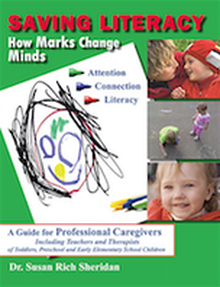
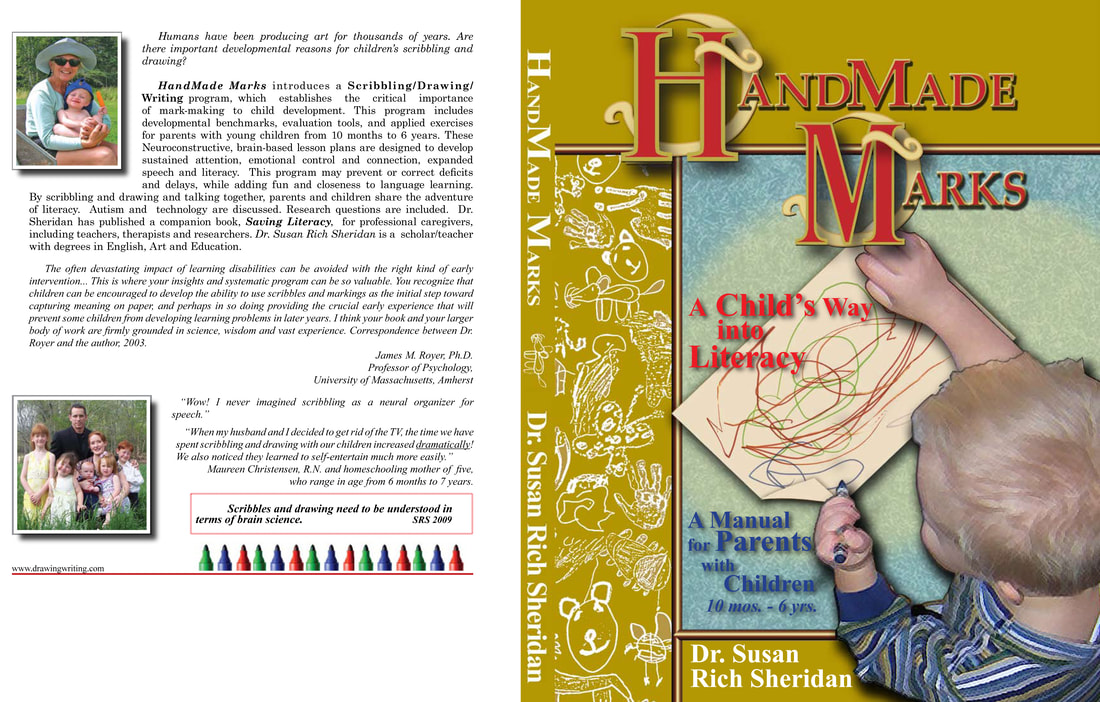
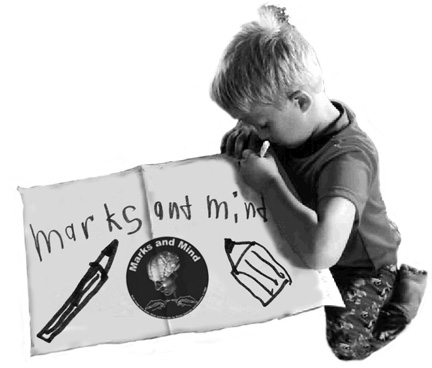
It is through these personal, powerful drawings that the student progresses into complex symbolic thought, including writing, reading, geometry, algebra ---- even into fractal mathematics. Uniquely, humans learn to represent thoughts outside their brains, and, then, to share them, using marks of meaning, and, of course, through spoken words, or speech. Marks and Mind is the name of an educational field of study. The theory supporting this field is Neurocontructivism, or, literally, brain-building. This new, whole-brain educational field - as well as the term "Neuroconstructivism" - was invented by Dr. Susan Rich Sheridan over a lifetime of teaching art and English to students K-12, and at the college level. By combining drawing (a right-brain activity) with writing (a left-brain activity), teachers and students experience a densely integrated and deeply exciting approach to writing and reading, or literacy. Because drawing is a natural mark-making system for children, they embark upon the adventure of marks-based communication in a natural way, with ease and enthusiasm, as well as with increasing confidence. Drawing comes "for free" in the human brain. Speech, and reading and writing must to be learned. This instructional approach, Drawing/Writing, is carefully outlined in the teacher manual Drawing/Writing the new literacy. The five-step program is also carefully outlined in Sheridan's other two books: Handmade Marks for parents and grandparents and early education teachers, and Saving Literacy, for educators, graduate students and educational research. This step-by-step program is designed to be taught from, directly. A teacher new to Drawing/Writing simply works through the exercises with the students, using a carefully constructed script, which is fully illustrated. Go to the PUBLICATIONS button to explore/order Drawing/Writing materials available directly from amazon.com. For background information on Neurocontructivism as well as about the practice called Scribbling/Drawing/Writing, see Dr. Sheridan’s papers, “The Scribble Hypothesis,” and “A Theory of Marks and Mind.” Click here for more information about the author. |
The new books, Saving Literacy and HandMade Marks, are described on the Published Books page, under the PUBLICATIONS button.
Click on the PUBLICATIONS button at the top of the home page (WHO ARE YOU?) for more information about all published works.
Click on the PUBLICATIONS button at the top of the home page (WHO ARE YOU?) for more information about all published works.
The New Literacy
To an unprecedented degree, a technological society requires communication skills. The ability to produce image as well as text is standard in this communication-rich world. Dr. Sheridan calls these complex skills "the new literacy." Children's natural drawing skills are often marginalized or misunderstood. Technology's requirements for a comprehensive visual/verbal literacy forces us to take a deeper look at children's spontaneous mark-making behavior - that is, at very young children's scribbling and drawing, and to respect this spontaneous behavior as the place where literacy - in all its variety and scope - begins. Dr. Sheridan's books meet this demand for a deeper look at mark-making by encouraging the capabilities of our brains for speech and symbolic thought at the place where this all starts -- in scribbling and drawing.
Being able to write and read depends upon core skills - including the ability to pay attention, and to communicate ideas, and to express emotions. These skills can be learned easily through training in drawing. Drawing is a universal skill. Everyone can draw. No one teaches us how. Drawing is a language instinct. Exercising this instinct gives children - and adults - joy, confidence, focus, increased intelligence.
When talking and writing accompany drawing, verbal skills grow. A two-fold literacy develops, both visual and verbal. This “new literacy " is as old as paleolithic cave drawings and as new as computer technology. As language-users, humans have two unique characteristics: speech, and marks of meaning. Speech begins with the sounds of babbles. Literacy begins with the shapes of scribbles. Scribbles are equipotential: they can become anything: drawing, writing, mathematics, musical notation.
The number of symbol systems any of us can learn depends upon opportunity, encouragement and instruction. It depends on our parents, our teachers, our environment, and our culture. Ultimately, it depends upon our brains and how we use them. It depends on simple tools, like pencil and paper.
Neurologically speaking, literacy is visual/verbal; it is both. The corpus callosum, a nerve-rich band of tissue in the brain connects the right and left hemispheres. This connective tissue creates a complex, cooperative unity- no matter what kind of thinking is going on. Drawing/Writing (the method of delivery for the new literacy) models integrated brain function. It works like the corpus callosum through the intentional combination of drawing with writing.
The more mark-making systems we use, the more powerfully we think. Multiple literacies should be our goal. A brain-full of symbol systems is our birthright.
When talking and writing accompany drawing, verbal skills grow. A two-fold literacy develops, both visual and verbal. This “new literacy " is as old as paleolithic cave drawings and as new as computer technology. As language-users, humans have two unique characteristics: speech, and marks of meaning. Speech begins with the sounds of babbles. Literacy begins with the shapes of scribbles. Scribbles are equipotential: they can become anything: drawing, writing, mathematics, musical notation.
The number of symbol systems any of us can learn depends upon opportunity, encouragement and instruction. It depends on our parents, our teachers, our environment, and our culture. Ultimately, it depends upon our brains and how we use them. It depends on simple tools, like pencil and paper.
Neurologically speaking, literacy is visual/verbal; it is both. The corpus callosum, a nerve-rich band of tissue in the brain connects the right and left hemispheres. This connective tissue creates a complex, cooperative unity- no matter what kind of thinking is going on. Drawing/Writing (the method of delivery for the new literacy) models integrated brain function. It works like the corpus callosum through the intentional combination of drawing with writing.
The more mark-making systems we use, the more powerfully we think. Multiple literacies should be our goal. A brain-full of symbol systems is our birthright.
Being able to write and read depends upon core skills - including the ability to pay attention, communicate ideas, and express emotions. These skills can be learned easily through training in drawing. Drawing is a universal skill. Everyone can draw. No one teaches us how. Drawing is a language instinct.
When talking and writing accompany drawing, verbal skills grow and a double literacy develops, a literacy which is both visual and verbal. This “new literacy " is as old as paleolithic cave drawings and as new as computer technology. As language-users, humans have two unique characteristics: speech, and marks of meaning. Speech first takes the sound of babbles. Literacy first takes the form of scribbles. Scribbles are equipotential: they can become anything: drawing, writing, mathematics, musical notation.
The number of symbol systems any of us learns depends upon opportunity, encouragement and instruction. It depends on our parents, our teachers, our environment, and our culture. Ultimately, it depends upon our brains and how we use them.
Neurologically speaking, literacy is visual/verbal; it is both. The corpus callosum, a nerve-rich band of tissue which connects the right and left hemispheres of the brain, insures that thinking is a complex, cooperative unity- no matter what kind of thinking is going on. Drawing/Writing (the method of delivery for the new literacy) models integrated brain function. It works like the corpus callosum by intentionally combining drawing with writing.
The more mark-making systems we use, the more powerfully we think. Multiple literacies should be our goal. A brain-full of symbol systems is our birthright.
When talking and writing accompany drawing, verbal skills grow and a double literacy develops, a literacy which is both visual and verbal. This “new literacy " is as old as paleolithic cave drawings and as new as computer technology. As language-users, humans have two unique characteristics: speech, and marks of meaning. Speech first takes the sound of babbles. Literacy first takes the form of scribbles. Scribbles are equipotential: they can become anything: drawing, writing, mathematics, musical notation.
The number of symbol systems any of us learns depends upon opportunity, encouragement and instruction. It depends on our parents, our teachers, our environment, and our culture. Ultimately, it depends upon our brains and how we use them.
Neurologically speaking, literacy is visual/verbal; it is both. The corpus callosum, a nerve-rich band of tissue which connects the right and left hemispheres of the brain, insures that thinking is a complex, cooperative unity- no matter what kind of thinking is going on. Drawing/Writing (the method of delivery for the new literacy) models integrated brain function. It works like the corpus callosum by intentionally combining drawing with writing.
The more mark-making systems we use, the more powerfully we think. Multiple literacies should be our goal. A brain-full of symbol systems is our birthright.